
Yes/No vs WH Questions
Learn when ASL yes/no questions use raised eyebrows and when WH questions use furrowed eyebrows, so your face shows the answer you expect.
Watch First
Use these short PocketSign clips to see the movement before you practice.
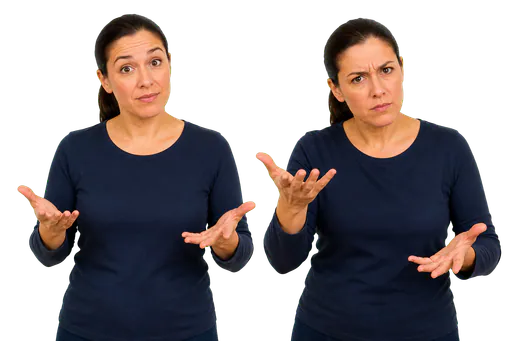
Using facial expressions with ASL is very important. When you're asking yes or no questions, you want to make sure your eyebrows are up. When you're asking any WH questions such as who, what, when, where, why, or how, you want to make sure you lower your eyebrows.
For yes or no questions, you want to raise your eyebrows to give a simple answer of yes or no, like opening a door for a quick response.
For our WH questions, you want to make sure your eyebrows are lowered. For detailed questions, as if you are focusing on specific information.
Learn It
Start with the simple version, then practice it with real signs.
The quickest way to choose the right question face is to ask, "What answer do I want?" In ASL, the signs alone do not always show the question type. Your eyebrows, eyes, and head position help the viewer understand whether you are asking for a yes or no answer or asking for specific information.
For ASL yes/no questions, use raised eyebrows, slightly open eyes, and often a small forward head position. This face tells the other person that a short answer like YES, NO, or MAYBE can work.
For ASL WH questions, use furrowed or lowered eyebrows and a focused look. WH questions ask for information such as a person, place, thing, time, reason, choice, or action, so the viewer expects more than yes or no.
Many beginner sentences can look almost the same in the hands, but the non-manual marker changes the meaning. YOU LIVE HERE? with raised eyebrows asks if the statement is true. YOU LIVE WHERE? with furrowed eyebrows asks for a place.
Practice the contrast in pairs. First ask a yes/no question with raised brows, then ask a WH question with furrowed brows. Keeping the signs simple lets you focus on the ASL question facial expression instead of trying to remember a long sentence.
This beginner rule covers the most common pattern: raised eyebrows for yes/no questions and furrowed eyebrows for WH questions. As you learn more ASL grammar, you will see timing and emphasis change, but this contrast is the clearest place to start.
Try It
Practice slowly. Make the face before the sentence is over.
- Turn into a yes/no question.
- Turn into a question.
- Ask ? with raised eyebrows.
- Ask ? with furrowed eyebrows.
- Ask ? with raised eyebrows.
- Ask ? with furrowed eyebrows.
- Ask ? with raised eyebrows.
- Ask ? with furrowed eyebrows.
- Practice switching between raised brows and furrowed brows without changing your hands too much.
Simple Examples
Read the ASL line first. A dark green pill names what your face or head is doing.
Common Mistake
Do not treat every question the same. A common beginner habit is to make one general "question face" for everything, but ASL uses different non-manual markers for different question types. If you raise your eyebrows for a WH question like YOU LIVE WHERE?, the viewer may briefly think you are asking a yes/no question. If you furrow your eyebrows for a yes/no question like YOU LIVE HERE?, the viewer may wait for a place, time, reason, or other detail instead of answering yes or no.
A little more grammar
ASL question grammar uses the face as part of the sentence, not as decoration after the hands are finished. The comparison between yes/no questions and WH questions includes brow position, eye shape, head position, and expected response. Raised eyebrows usually signal a yes/no question, while furrowed eyebrows signal a WH question that asks for information. Beginners can start with the brow rule, then add timing: hold the raised brows through the yes/no question, and keep the furrow connected to the WH question, often strongest on the WH sign itself. This is why simple paired practice is useful for learning ASL grammar. You can sign short lines like YOU WANT WATER? and YOU WANT WHAT? while training your face to tell the viewer exactly what kind of answer you expect.