
Holding Facial Markers
In ASL, facial markers usually stay active over the part of the sentence they control. Learn how to hold raised eyebrows for yes/no questions and connect furrowed brows to WH questions.
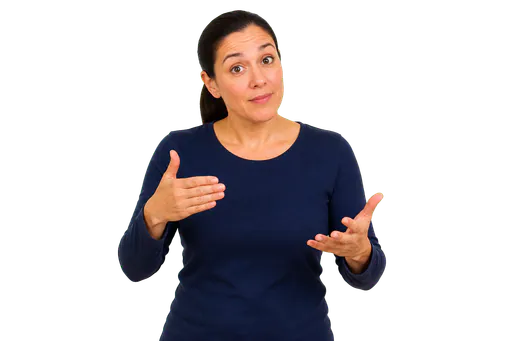
Watch First
Use these short PocketSign clips to see the movement before you practice.
For yes or no questions, you want to raise your eyebrows to give a simple answer of yes or no, like opening a door for a quick response.
For our WH questions, you want to make sure your eyebrows are lowered. For detailed questions, as if you are focusing on specific information.
Learn It
Start with the simple version, then practice it with real signs.
A facial marker is the face, eyebrow position, head tilt, or eye focus that marks the grammar of an ASL sentence. These non-manual markers do not work like quick decorations. They usually have timing, and that timing tells the viewer which signs belong together.
For a simple ASL yes/no question, hold the raised eyebrows through the whole question. If you sign TOMORROW YOU WORK? the raised brows should stay active from TOMORROW through WORK, because the full sentence is asking for a yes or no answer.
For an ASL WH question, the furrowed brows may cover the whole question or become strongest on the WH sign. In a short sentence like YOU GO WHERE?, many beginners can think of the WH face as connected to the whole question, with extra focus on WHERE.
The important beginner habit is not intensity. It is timing. A small, clear eyebrow raise or brow furrow is better than a big expression that starts late or disappears before the sentence is finished.
This is why ASL facial grammar practice should use simple sentences first. When the signs are easy, you can pay attention to when the face starts, how long it stays, and when it relaxes.
After the question or marked phrase ends, let the face release. That small return to neutral helps the viewer see the boundary between one idea and the next.
If you are recording yourself, watch the video without sound and focus only on your face. You should be able to see the question face during the signs, not only after your hands stop moving.
Learning to hold facial markers is one of the fastest ways to make beginner ASL grammar clearer because the hands and face start working as one sentence instead of two separate actions.
Try It
Practice slowly. Make the face before the sentence is over.
- Sign ? and keep raised eyebrows through all three signs.
- Sign ? and hold raised eyebrows from through .
- Sign ? with raised eyebrows on the whole short question.
- Sign ? and keep the yes/no question face until is finished.
- Sign ? with raised eyebrows, then relax your face after the question.
- Sign ? and make the furrow strongest at .
- Sign ? and keep the face connected to the whole question.
- Sign ? with furrowed brows through .
- Sign ? and hold the furrow until is finished.
- Record yourself and check whether your face drops too early.
- Practice one sentence twice: first with the face only at the end, then with the face held correctly. Notice how much clearer the second version feels.
Simple Examples
Read the ASL line first. A dark green pill names what your face or head is doing.
Common Mistake
Do not smile, relax, blink away, or look off to the side before the question is finished. Dropping the face too early can make the sentence unclear because the viewer loses the non-manual marker before the grammar is complete. Another common mistake is adding the face only after the hands are done, as if the expression were punctuation at the end. In ASL, the facial marker should overlap with the signs it controls.
A little more grammar
The reference document calls this the syntactic domain. In simple terms, the marker has a span: it covers the word, phrase, or sentence part that it belongs to. A yes/no question often has raised eyebrows across the full question, while a WH question may spread the furrow across the question or concentrate it near the WH sign. This timing is one reason ASL grammar is visual and simultaneous. Your hands provide the signs, and your face shows how those signs fit together. When learners hold facial markers with the right timing, ASL questions become easier to read, more natural, and less dependent on English word order.