
Facial Grammar Basics
Your face is part of ASL grammar. It helps show if you are making a statement, asking a question, giving a command, or setting up an idea.
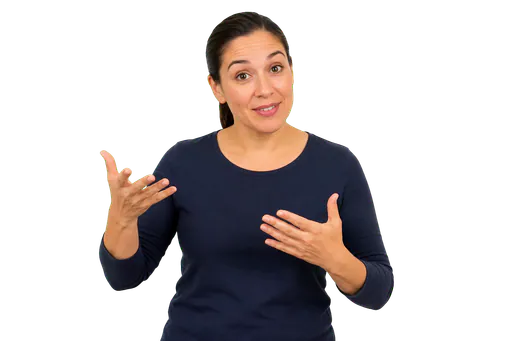
Watch First
Use these short PocketSign clips to see the movement before you practice.
Facial expressions, head movement, and body language are all non-manual markers that we use in ASL while we are signing. These signals add emotion and clarity to our signs.
Here are some examples. Yes, that is a non-manual marker that is understood universally as affirmation. No, no. The head shake is a universal known gesture for no. The non-manual marker of happiness is a smiling mouth and brightening eyes to enhance that you are happy. Confused. A frowned eyebrow and a perplexed facial expression enhance the sign for confused.
Learn It
Start with the simple version, then practice it with real signs.
In ASL, your hands carry many of the signs, but your face helps show how the sentence should be understood.
Your eyebrows, eyes, head position, and body lean work with your hands. The viewer reads them together, not as separate pieces.
For this first lesson, do not try to memorize every facial marker. Just notice when your face is calm, when it looks like a question, and when it matches the meaning of the sentence.
A small, clear face is enough. You do not need to act huge or make a dramatic expression for every sign.
Practice with the same signs more than once. First sign them with a calm statement face, then sign them again with a simple question face.
This page is mostly a noticing drill. Each time you sign, ask yourself one simple question: does my face match what I mean?
Keep your face easy to see. If you look down, turn away, or hide your mouth behind your hands, the viewer loses part of the grammar.
Beginners often focus so hard on the hands that the face freezes. Slow down enough that your hands and face can start together.
It is normal for facial grammar to feel awkward at first. Practice tiny sentences until the face feels like part of the sign, not something extra you add later.
Use the examples as repetitions, not as new rules. The goal is comfort: calm face for telling, simple question face for asking, and a face that matches the sentence.
Think of facial grammar like the tone of voice in spoken English. It is not decoration. It is part of the message.
Try It
Practice slowly. Make the face before the sentence is over.
- Sign with a neutral face. That means "You are going."
- Sign again with a simple question face. Now it means "Are you going?"
- Sign with a calm face. Let it feel like you are giving information.
- Sign ? with a question face. Keep the expression friendly and clear.
- Sign with a calm face, then sign ? with a question face.
- Sign with a calm face. Then sign ? with a simple question face.
- Sign with a calm face. Then sign ? with a simple question face.
- Sign with a calm face. Then sign ? with a simple question face.
- Pick one easy sign you already know. Sign it once like a statement and once like a question.
- Record two short versions of the same line. Watch with the sound off and see if your face makes the meaning clear.
- Practice in front of a mirror for one minute. Relax your face between attempts so each new sentence has a fresh expression.
- Watch yourself in a mirror or short recording. Check whether your face matches what you meant to say.
Simple Examples
Read the ASL line first. A dark green pill names what your face or head is doing.
Common Mistake
Do not sign with a blank face all the time. A blank face can make questions and emotions hard to read. Another common beginner mistake is making the face so big that it looks fake or hard to keep. Aim for clear, natural, and matched to the sentence. If the face feels uncomfortable, make the sentence shorter instead of dropping the face completely.
A little more grammar
The source document calls facial grammar a syntactic engine. In simpler words, your face helps run the grammar of the sentence while your hands show the main signs. At this level, the important habit is awareness: when you practice a sentence, also practice the face that belongs with it. Later lessons separate different question faces and deeper patterns, so for now keep the goal simple: make the viewer see whether you are telling or asking.