
CL:B for Flat Surfaces
CL:B can show flat things and surfaces like tables, shelves, floors, roads, walls, doors, and paper.
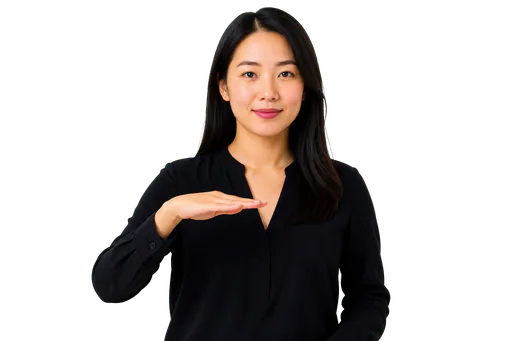
Learn It
Start with the simple version, then practice it with real signs.
CL:B uses a flat hand with the fingers together. It is useful for surfaces and flat objects.
Palm down can show a horizontal surface, like a table, shelf, floor, or road.
Palm forward or sideways can show a vertical flat thing, like a wall, door, or fence.
Try It
Practice slowly. Make the classifier movement clear and keep the location steady.
- Sign , then hold CL:B palm down to show the tabletop.
- Sign , then hold CL:B palm forward to show the wall in front of you.
- Hold non-dominant CL:B as a road, then move CL:3 over it like a car driving.
Simple Examples
Read the ASL line first. A dark green pill explains the classifier movement, not an extra sign.
Common Mistake
Do not forget palm orientation. CL:B palm down and CL:B palm forward can mean different kinds of surfaces.
A little more grammar
CL:B often works as the ground in a scene. Once the flat surface is set, another classifier can be placed on it or moved across it.