
Backward Verbs
A few directional verbs feel backwards at first. TAKE and BORROW often move from the source toward the person who receives the thing.
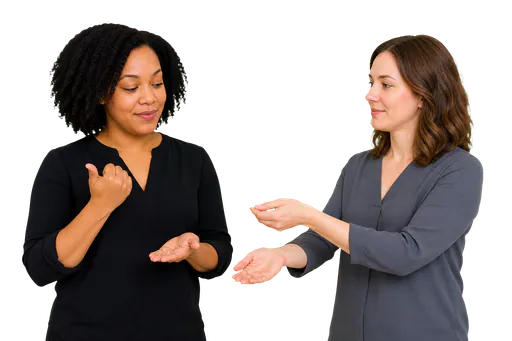
Learn It
Start with the simple version, then practice it with real signs.
Most directional verbs move from the doer toward the receiver, but a few follow the thing being received.
TAKE and BORROW are the easiest examples to start with.
If I borrow from you, the item comes from you to me, so the movement comes toward me.
Think about where the thing starts and where it ends. That makes the direction easier to remember.
Try It
Practice slowly. Watch how the hand movement changes the meaning.
- English:I borrow from you.Decide the source:The item starts with you and comes to me.Now sign: BORROW-from-you.
- English:She takes from him.Decide the source:Set HIM on the left and HER on the right, then move TAKE from him toward her.Now sign:HIM-left, HER-right, left-to-right.
- English:I give to you, then I borrow from you.Decide the contrast:GIVE moves away from me, but BORROW-from-you comes back toward me.Now sign: GIVE-you, BORROW-from-you.
Simple Examples
Read the ASL line first. A dark green pill names the hand movement or lack of extra movement.
Common Mistake
Do not force every directional verb to move from the doer to the receiver. For BORROW and TAKE, follow the thing being received.
A little more grammar
Backward verbs are still directional verbs. They just use a different logic: the path often shows the movement of the object, not the action from the doer.